The Essentials of Buddhism: The Mind-Ground Method
Author: Master Qingliangyue
Overview
This is an overview by Qingliangyue on the Buddhist mind-ground method. With its scientific spirit of empirical practice, Buddhism helps one attain fundamental liberation of mind and recovery of body. Using the metaphor of a double-layered lantern — the candle flame as the true mind and Tathāgatagarbha, the red and green lantern paper as the sixth and seventh consciousnesses — the article describes in three steps the inner journey from cultivating concentration, to releasing thoughts, to experiencing the difference between thoughts and awareness.
With its scientific spirit of empirical practice, Buddhism enables later generations to attain fundamental liberation of mind through the study of Buddhism, and at the same time to bring about the greatest possible recovery of the body. It is precisely because the Buddhist mind-ground method has carried out such fruitful exploration of human physical and mental health that we modern people, in an age awash with material desire and the prevalence of hedonism, can obtain a tranquility like that of a utopian refuge and find a safe haven for the mind. Let us now use the diagram above to systematically explain the core theory of Buddhism: the mind-ground method.
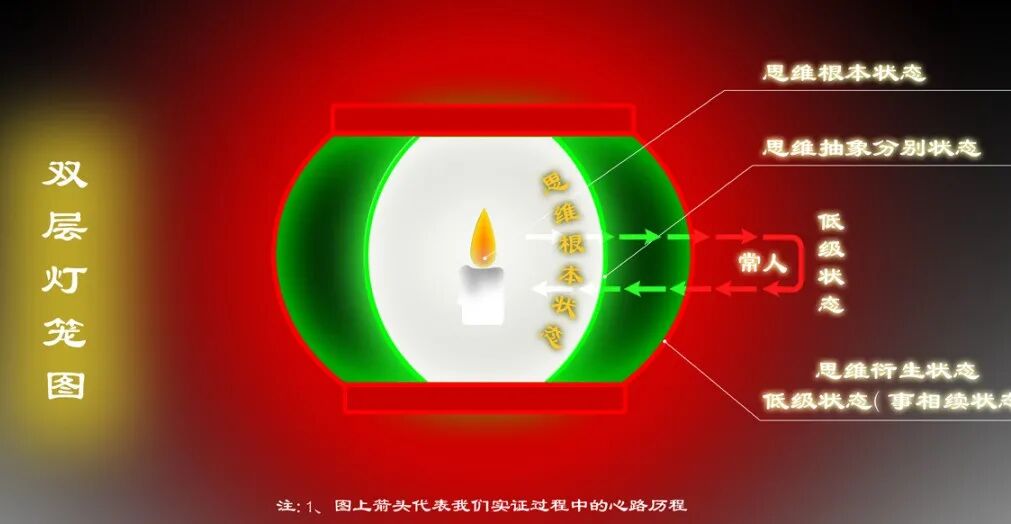
The diagram above is a double-layered lantern. The candle flame inside represents the original state of our mind — what we commonly call the true mind, the Tathāgatagarbha, the original face, bodhi, Chan, true thusness, suchness, awareness, the mind of great compassion, self-nature, and so on. The two outer layers of lantern paper represent the sixth consciousness (consciousness, red) and the seventh consciousness (manas, green).
The sixth consciousness refers to the continuity of mental activity. For example, when you fall in love at first sight with someone, you cannot help thinking of them in everything you do — your mind is like a runaway horse that cannot stop. This is the continuity of consciousness. The seventh consciousness is the discriminating and clinging consciousness: when you eat, you cannot help distinguishing between delicious and not delicious; what is delicious you cannot help liking, while what is not delicious feels like chewing sawdust — this is discrimination and clinging. The arrows in the diagram represent the inner journey of our empirical practice.
We ordinary people live in the mental state on the outside of the lantern. The pure, undefiled light of mind shines from within, but after passing through the contamination of the sixth and seventh consciousnesses it becomes the two colors red and green. This forces you to become a slave of your mind. No matter how eloquently a psychological counselor analyzes and explains, and no matter how invincible Ah Q's spiritual victory method may be, none of it helps you — because you are, after all, in deep water and hot fire; those people are merely on the shore encouraging you to hold on. Can a painted pie satisfy hunger? Can gazing at plums truly quench thirst? Those who have suffered great psychological trauma know best the feeling of a dead heart.
How can one become master of one's own mind? How can one truly become the master of one's own mental activity? This is the fundamental task of the Buddhist mind-ground method. Here is a brief introduction to the method; if you wish to delve deeper, several of our other articles may serve as references.
Step One: Cultivate concentration. Continuously and for a long time, single-mindedly contemplate one action or one object, or listen to a sound, and so on. In this way, gradually reach a state in which there is no bodily sensation at all. At this point, you will clearly see one thought subside, and only after a gap will the next thought arise. The continuity of thoughts is completely eliminated — in other words, the faculty of consciousness is subdued.
Step Two: Continuing from above, each time a thought arises, you must see it with perfect clarity, then release it with a gentle mind. You will find that the interval between thoughts grows longer and longer. At this point, use the thought of selflessness to imagine merging yourself with all of nature. You will find that thoughts disappear, yet your mind remains perfectly clear and your awareness is very active. For the first time, you realize that thoughts and awareness are not always the same thing. At the same time, you will find that you can no longer get angry — even if you try to make yourself angry again, you discover how difficult that is.
Step Three: Those who have reached the second step often miss the former state in which they could get angry — this is habitual tendency. So they exert all their effort to imagine what anger is like. After a period of arduous effort, they finally find that a mental force clearly begins to move, immediately followed by the first thought, "I," then "he," and then pairs of opposing thoughts arise in succession — love and hate, liking and dislike, and so on. This is the seventh consciousness. As it develops, you will fixate on one specific, most impressive matter and think about it continuously — this is the sixth consciousness. You have finally returned to the former state of pathological mental activity.
This is the entire inner journey of the Buddhist mind-ground method. Is it not a fine medicine for treating psychological illness? It can cure your psychological illness at its root and let you become the master of your own mind — something that no ordinary psychology can accomplish.
Comments
No comments yet. Be the first to share a thought.
Related Articles
- [Mind Contemplation Series] 1: Those Who Contemplate the Mind Attain Ultimate LiberationMind contemplation has always held a vital position in Buddhism as a method of liberation passed down from the ancients. "Those who can contemplate the mind attain ultimate liberation." This article explains the crucial key of contemplating after achieving bodily emptiness, and the essential difference between mind contemplation and meditative absorption.
- The Empirical Steps of Chan BuddhismA summary by Qingliangyue of the Chan path of practice: from clarifying the mind and breaking the first barrier, to the great awakening of returning to the Tathāgatagarbha, and finally to the freedom of matter at the eighth stage — three steps with a clear underlying principle.